
close
Generic selectors
Exact matches only
Search in title
Search in content
Post Type Selectors
Search in posts
Search in pages
product
Holiday Sale | 30% Off All Books (Dec 1-25) Nourish the mind this season.

Secret Drugs of Buddhism by Mike Crowley

Secret Drugs of Buddhism by Mike Crowley

Delving into the Secret Drugs of Buddhism

Did the Buddhists of the ancient world make use of shamanic plants and psychedelic sacraments in their sacred rituals? This is the broad topic that Buddhist lama and author, Michael Crowley, attempts to unfurl in his book Secret Drugs of Buddhism: Psychedelic Sacraments and the Origins of the Vajrayāna. Crowley’s book is the culmination of over forty years of research exploring the extensive historical evidence for the use of entheogenic plants within the Buddhist tradition.

It is often supposed that Buddhism is and has always been ‘drug-free’, and is rather something that is practiced entirely by one’s own efforts. This view of Buddhism can be thought to stem from the fact that Buddhism has largely taken root in global consciousness through the work of the exiled Tibetan leader and Buddhist teacher, H. H. The Dalai Lama. Nowadays, there is a common misconception that the Buddhism practiced in Tibet is representative of all Buddhism and that it is the default, normative version of Buddhist practice.  

However, the book focuses on an earlier form of Buddhism, known as Vajrayāna Buddhism. The Vajrayāna movement of Buddhism began in the 5th and 6th centuries AD. The scriptures of the Vajrayāna continually make reference to a sacrament called amrita, the term for ‘immortality’ in Sanskrit. The term amrita is significantly older than the Vajrayāna and was used within the ancient Indian scripture, the Rig Veda, (composed c. 2000 BC) as a synonym for soma, the divine intoxicant.

A Closer Look at the Vajrayāna

Drawing on scriptural sources, botany, pharmacology, and religious iconography, the book calls attention to the central role which psychedelics have played in Indian religions. It traces their history from the mysterious soma, venerated in the ancient Hindu scriptures, to amrita, the sacramental drink of the  Vajrayāna. Although the amrita used in modern Vajrayāna ceremonies lacks any psychoactivity, there is copious evidence that the amrita used by the earliest Vajrayāna practitioners was a potent entheogen.

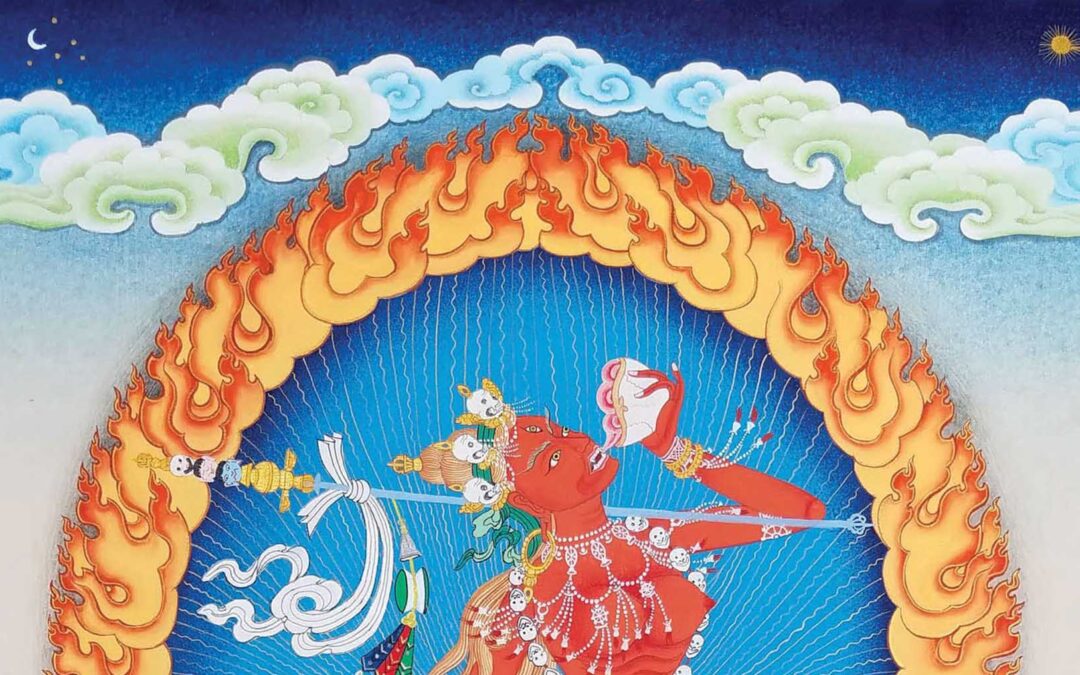
A glance at the titles of Vajrayāna scriptures will find the word amrita again and again. Many Vajrayāna deities have amrita as part of their name and a liquid called amrita is frequently visualized in Vajrayāna meditations. Almost all the early teachers of the Vajrayāna are depicted holding skull-cups of amrita. Two “skull-cups” of amrita adorn Vajrayāna altars and a drink called amrita is consumed at all major Vajrayāna rituals. Hundreds of Vajrayāna deities are said to carry amrita in some form, whether in a skull-cup, vase, flask or bowl.

Consider, for example, the prominent meditation-deity Hevajra. He is usually described and depicted as having sixteen arms with every hand holding a skull-cup filled with amrita and in one of his several variants he and his tantric consort arise out of the amrita itself.

And yet, despite multiple references in Vajrayāna literature and near-ubiquitous depictions in Vajrayāna art, you may be forgiven for never having heard of amrita before. If you are, as I am myself, a practicing Vajrayānist, then you may have performed the Vajrasattva purification practice in which the body is (mentally) filled with amrita. But the actual nature of amrita, its origin and history, are rarely discussed, if at all. In fact, even a standard textbook which provides a detailed account of Vajrayāna Buddhism as practiced in India and Tibet has managed to overlook it entirely.

2nd Edition of Secret Drugs Coming Out Fall 2019

We are excited to announce that this upcoming Fall 2019 we are scheduled to publish the 2nd edition of Secret Drugs of Buddhism. Don't miss out on our pre-order discount, and order your copy with us now!

Pre-order Secret Drugs of Buddhism

Interview on Adventures Through the Mind Podcast 

Learn more about Secret Drugs of Buddhism through this fascinating podcast interview with James W. Jesso, 2016. In this episode, Michael unpacks symbolism within the Vajrayāna tradition, examining the vast history of Buddhism, and retells the story of how the book came to be!


Upcoming Author Events

June 21st, 7:30-9:00 PM, An introductory explanation of Hinayana, Mahayana, and Vajrayāna @ SF Dharma Collective

3 classes: Friday, June 21, July 5th, and August 2nd. The talks provide a basic outline for understanding the different philosophies, meditations, and practices of the three vehicles, as well as their historical context. Each of the three sessions will include a meditation session appropriate to the vehicle under discussion.

Want to know more? Check out the SF Dharma Collective's Calendar.


More About Michael Crowley 
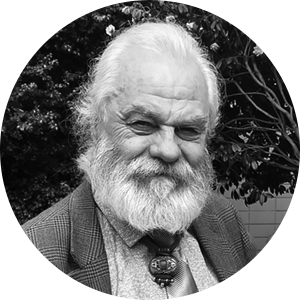
Michael Crowley was born February 26th, 1948 in Cardiff, Wales. He began studying Buddhism with a Tibetan lama in 1966, becoming an upasaka of the Kagyud lineage in 1970. In order to augment his Buddhist studies, he acquainted himself with Sanskrit, Tibetan, and Mandarin Chinese. Mike has lectured at the Museum of Asia and the Pacific, Warsaw, the Jagiellonian University, Cracow, the California Institute of Integral Studies, San Francisco, and at the University of Wisconsin-Madison. His work has been published in Fortean Times, Time and Mind: The Journal of Archaeology, Consciousness, and Culture, Psychedelic American, and Psychedelic Press UK. In January 2016, Mike received the R. Gordon Wasson Award for outstanding contributions to the field of entheobotany. He currently serves on the advisory board of the Psychedelic Sangha, a group of psychedelically-inclined Buddhists, based in New York and he teaches at the Dharma Collective in San Francisco.


Praise for Secret Drugs of Buddhism 

Mike Crowley has manifested a delightful book on a topic rarely spoken of, and certainly never explored with such depth. With a combination of personal anecdotes, detailed historical research, and a large collection of traditional art, this book will encourage modern-day Buddhist yogis and mind-explorers to see their practice and its roots in a new way.  —Rev. Kokyo Henkel, Head Teacher, Santa Cruz Zen Center

Writing clearly, in the fashion of an investigative reporter, Mike Crowley unlocks the mystery of amrita, and answers, with previously unseen certainty, the question of whether or not psychedelics were part of historical Buddhist practice. Allan Badiner, Co-editor of Zig Zag Zen: Buddhism and Psychedelics

Psychedelic drugs in ancient Buddhism? Believe it. Don't believe it? Read this book. —Clark Heinrich, Author of Magic Mushrooms in Religion and Alchemy
Extinction Rebellion: Rebel for Life

Extinction Rebellion: Rebel for Life

Extinction Rebellion: A Call for Direct Action

In response to the global climate crisis, Extinction Rebellion has emerged as a direct action movement. Originally a UK based initiative, Extinction Rebellion began on 31st October 2018 when a small group of individuals gathered together on Parliament Square in London to make a ‘Declaration of Rebellion’ against the UK Government. Anticipating only a couple of hundred people to attend, organizers were surprised by the 1500 that gathered to peacefully protest for the climate crisis.

Encouraged by the show of solidarity, the movement quickly gained momentum with protests springing up all throughout the UK. In the weeks that followed, a group of 6000 converged to block five major bridges across the Thames river whilst others superglued themselves to the gates of Buckingham Palace to read letters to the Queen. Naturally, these protests generated huge national and international publicity, with thousands of people around the world finding Extinction Rebellion’s message to be resonant. There are now groups forming in countries far and wide, with people of all nations banding together to take action while we still have a chance. At Synergetic Press, we want to encourage this movement. Here are links to key talks and networks to help you get involved.

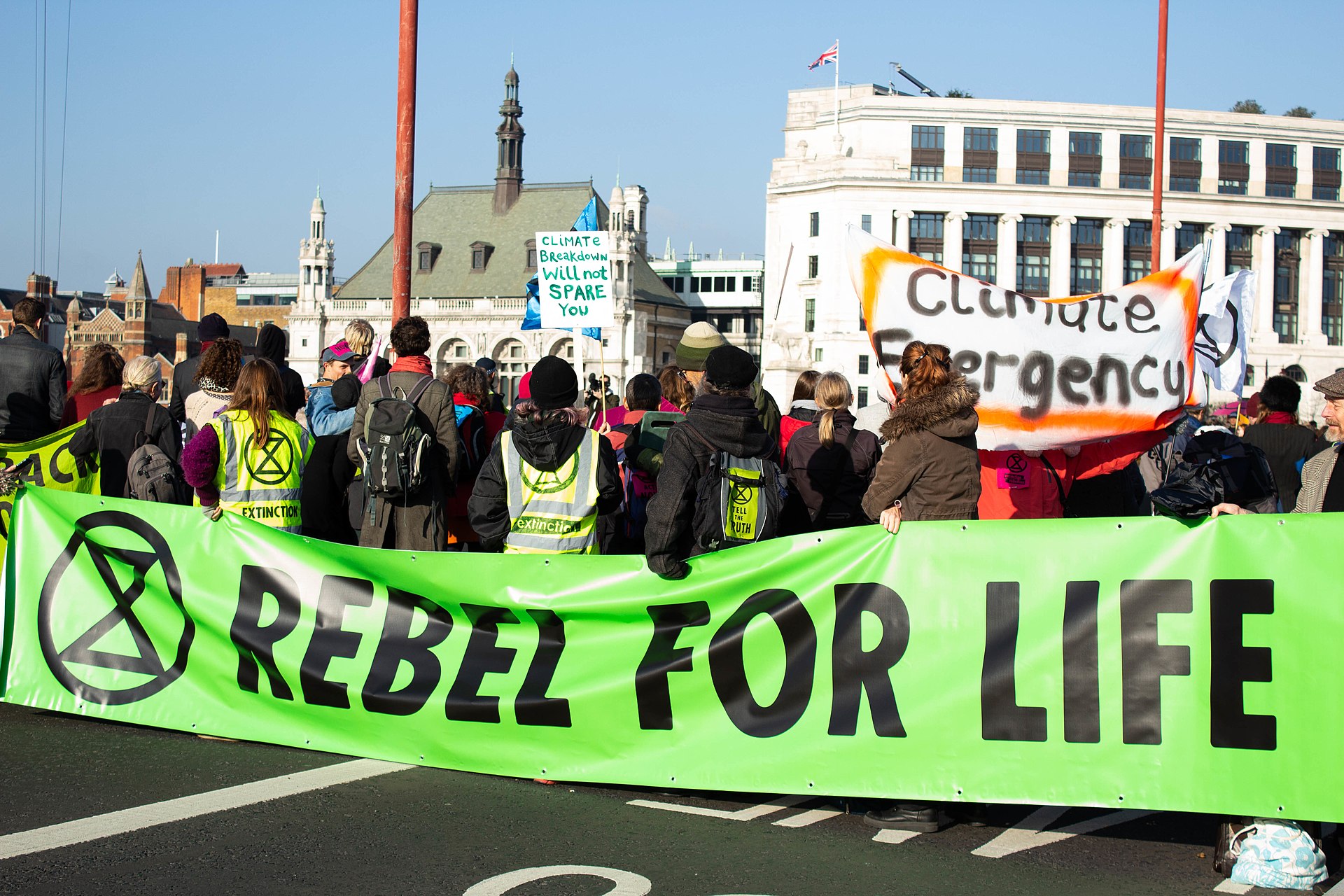
Protestors at the Extinction Rebellion Protest in Blackfriars London November 2018 via Wikicommons
Extinction Rebellion's occupation of Waterloo Bridge, London during the International Rebellion, April 2019

Extinction Rebellion stated their mission as follows:

"To spark and sustain a spirit of creative rebellion, which will enable much-needed changes in our political, economic and social landscape. We endeavor to mobilize and train organizers to skillfully open up space so that communities can develop the tools they need to address Britain’s deeply rooted problems. We work to transform our society into one that is compassionate, inclusive, sustainable, equitable and connected."

Greta Thunberg & Youth Climate Action

Teenage climate campaigner, Greta Thunberg, gave a speech at the recent Extinction Rebellion protest at Marble Arch, London, April 21st, 2019, expressing her solidarity with protesters in their mission to combat the climate crisis. In her speech, Greta made an appeal to the 'politicians and people in power', imploring for urgent action to be taken:

“We are now facing an existential crisis, the climate crisis and ecological crisis which have never been treated as crises before. They have been ignored for decades and for way too long the politicians and the people in power have gotten away with not doing anything. We will make sure that politicians will not get away with it for any longer.”

Greta first came to attention in the media when she initiated the 'School Strike 4 Climate' movement in November 2018 in which students gathered together outside of the Swedish Parliament in Stockholm to protest for their right to a better future. After her participation in the United Nations Climate Change Conference (COP24), she made her way into international media and now serves as a source of inspiration for all, championing a global movement to reduce carbon emissions. Earlier this year, March 15, 2019, an estimated 1.4 million students in over 100 countries around the globe joined Greta’s call to strike school and band together in the name of the climate.

Follow Greta on Twitter @GretaThunberg, or Facebook @GretaThunbergSweden.

This is an Emergency: The Urgency to Act Now

Over the last century, industrialized human civilization has irrevocably upset the natural balance of life, and as a consequence, our planet is facing the largest rate of extinction since the loss of the dinosaurs 65 million years ago. We are now living the 6th largest mass extinction, with the rapid loss of species estimated to be between 1000 and 10,000 times higher than the natural extinction rate. It is thought that many current life forms could be wiped out by the end of this century, with multiple species disappearing before we even get the chance to learn about them.

No puns intended when we say that ‘this is only the tip of the iceberg.’ Human activity on the planet has caused global temperatures to rise. The UN Intergovernmental Panel on Climate Change (IPCC) released the Special Report on Global Warming of 1.5 °C which unnervingly warns of a strong risk of global crisis as early as 2040. The report was written and edited by over 90 scientists from over 40 countries analyzing more than 6000 studies. Their report suggests that if we do not reform our global economic system drastically in the next few years, and we keep continuing to let off large carbon emissions into the atmosphere as well as using coal as an energy source, we will begin to see the worsening of food-shortages, wildfires, the mass die-off of coral reefs as well as the beginnings of coastal flooding.

Curious to learn how much hotter your hometown is compared to when you were born? The New York Times has developed an interactive resource which demonstrates how much warmer your hometown has become throughout your lifespan.

There is an urgency to act whilst we still have the opportunity to. As a species, we can no longer ignore what the science keeps telling us. The solution to combating the devastating impacts of anthropogenic activity to life on Earth, lies in banding together and taking collective action to reduce our carbon emissions, improving our carbon absorption and finding methods of drawing and locking carbon back into the Earth once more.

Find out how you can do more to individually reduce your carbon emissions and care for the environment in our last blog post for Earth Day 2019.

Join the Rebellion

Extinction RebellionExtinction Rebellion is an international direct action movement that uses non-violent civil disobedience to achieve radical change in order to minimize the risk of human extinction and ecological collapse. They demand that governments should tell people the truth about the ecological crisis. Further, putting pressure on them to work towards zero emissions and a drawdown by 2025 as well as the establishment of participatory democracy.

Interested in getting involved? Find out about Extinction Rebellion events through

xrebellion.org, or @ExtinctionRebellion.

Earth Day 2019 and Protecting Our Biosphere

Earth Day 2019 and Protecting Our Biosphere

Earth Day 2019 & Protecting Our Biosphere

Earth Day began on April 22nd, 1970, as millions of people took to the streets to protest the negative impacts of 150 years of industrial development. Earth Day offers an important opportunity for us to acknowledge the relationship between humanity and the earth.

Earth Day now serves as a day to reflect and cultivate awareness for the responsibility that we have towards our planet and the interconnected web of life that it sustains. It is similar to Mother’s Day in that it involves the cultivation of gratitude for the Source, Mother Nature, which gifted us with this precious life. However, it also encourages us to come together, get creative, and start enacting change.

The national theme of Earth Day this year is ‘Protect Our Species’. Human activity on the planet has irreversibly upset the balance of life and, as a consequence, the planet is facing the largest rate of extinction since the loss of the dinosaurs at the end of the Cretaceous period 65 million years ago. Unlike the fate of the dinosaurs, the extinction of species today is a result of human activity rather than of a force of Nature.

The Anthropocene Era

In our industrialized, globalized paradigm we have become increasingly disconnected from the natural world at our own peril, with the problems being numerous and multifaceted. Ecologically speaking, we live in turbulent times with the Anthropocene era being one of rapid change. We currently inhabit a world where our oceans are filled with plastic, a world where the problems of deforestation and climate change are becoming a looming reality, a world undergoing a dramatic loss of biodiversity, with new problems arising every day.

From Micro-to-Macro; You Make a Difference

Getting stuck in sentiments of hopelessness and disempowerment, while feeling that our voices and actions do not matter, is all too easy. However, Earth Day offers the opportunity to reflect on our actions and implement changes that enable us to carve out a symbiotic paradigm between our species and the biosphere.

In line with the words of the great primatologist, Jane Goodall, we need to recognize that the choices we make have an impact and that what we do in our personal lives makes a difference on a global level:

“You cannot get through a single day without having an impact on the world around you. What you do makes a difference and you have to decide what kind of a difference you want to make.”

To help you along the way, we have included two simple things that you can implement into your life on a daily basis as methods to combat this ecological crisis:

1. Boycott single-use plastics:

Plastic was invented in 1907 and popularized in the 1960s as a high-density polyethylene that was inexpensive to manufacture. Its inventors could have not predicted its catastrophic effect on our Biosphere and the biomes within it. Plastic is a major threat to our environment, with plastic pollution being particularly problematic to aquatic life.

The problem with plastic is that it does not biodegrade, instead breaking down into microplastics which are consumed by other organisms. In recent years, there have been numerous cases reported in which whales have washed up ashore dead due to the ingestion of plastic. Moreover, plastic ends up in the digestive systems of smaller organisms like fish which inevitably end up in our food chain.

Although it can be difficult to boycott plastic altogether, we can take small actions on a daily basis to minimize our consumption. For instance, remembering to bring a reusable bag or reusing one we already have, saying no to straws, sourcing environmentally friendly toothbrushes, owning a reusable water bottle, buying biodegradable bin liners, bringing a food container and buying plastic-free cosmetics all make a huge difference.

A report from the World Economic Forum calculated that if plastic production continues at its current rate that there will be more plastic in the ocean, pound for pound, than fish by the year 2050. Reducing our plastic consumption and making informed, sustainable choices is one of the most effective ways to protect our species.

2. Eating less & better quality meat:

A report by the United Nations’ Food and Agriculture Administration in 2013 found that livestock and poultry make up roughly 14.5% of anthropogenic greenhouse gas emissions, estimated as 100-year CO2 equivalents. Methane has a global warming potential estimated to be 35 times that of an equivalent mass of carbon dioxide.

According to the World Wildlife Fund, in the Amazon “around 17% of the forest has been lost in the last 50 years, mostly due to forest conversion for cattle ranching.” The Amazonian rainforest is the world’s largest, sometimes referred to as the ‘lungs of the Earth’ because it is thought that more than 20% of the world’s oxygen is produced there. Moreover, the Amazon is one of the world’s most biodiverse regions. It is estimated to be home of 390 billion trees, among them 16,000 different species, and is the tribal home of 1 million indigenous people.

Cattle ranching alongside the production of soya as cattle feed is a major contributor to deforestation, the displacement of indigenous groups, and the destruction of entire ecosystems. Moreover, the production of factory-raised cattle is often associated with toxic fertilizers and pesticides, resulting in an even more damaging carbon footprint.

These crucial forests are not only incredibly biodiverse but also serve to absorb carbon dioxide and have a cooling effect on the earth. In order to protect them, it is important for us to be aware of the source of our meat. Grass-fed cows have a symbiotic relationship with the land that they graze, clearing pastures to encourage new plant growth and helping build productive soil with nutrient-rich compostable manure. Fertile soil helps to keep carbon monoxide at bay, decreasing methane emissions.

Producing one calorie of meat requires nearly twenty times the amount of energy as one plant calorie. Thus, by cutting down on meat consumption and sourcing locally raised, grass-fed meat we can reduce the carbon footprint of the planet drastically.


To help you deepen your understanding of our beloved planet, we are offering 25% on all books in the field of ecology & sustainability. Browse titles here.

Save 25% from now until April 30th with the coupon code: Earth2019


Get Involved!

Local Events this Earth Day 

Earth Day Celebration in Santa Fe's Railyard Park, April 27th @ 12:00-4:00 PM

Join the Railyard Park Conservancy in for a free day of learning, games, workshops and family-friendly fun!

Enjoy an illuminating day in the sun at Santa Fe’s award-winning green space, The Railyard Park, to celebrate the Earth and local biodiversity in honor of 2019’s national Earth Day theme: Protect our Species.

We will be joining together to learn about the unique biodiversity of New Mexico and its treasure trove of plants, animals, and geology with a number of interactive activities. Workshops include: making seed balls with the SFPS Sustainability Program, learning how to plant a native garden with the SF Botanical Garden, and learning about local dairy production with Camino de Paz School, just to name a few.

Keep up to date with the Railyard Park’s cool and interesting events through their Facebook @railyardpark or webpage.

Earth Day Cleanups

The Earth Day Network is coordinating volunteer cleanups across the US for Earth Day 2019. They are working with grassroots organizations and community members to clean up green spaces, urban landscapes, and waterways. With cleanup locations in cities across the U.S., the Earth Day 2019 Cleanup will build an army of volunteers and make a tangible impact on waste in our environments.

Find a cleanup near you! Learn more about Earth Day Network events @EarthDayNetwork.